Your STR May Be Performing Well. But Is Your Equity?
The overlooked number that can completely change how you view a short-term rental investment

Short-term rental owners tend to know their numbers.
Ask an experienced owner about last year's gross revenue and there's a good chance they can tell you. They probably know their average daily rate, occupancy, management percentage, mortgage payment and whether bookings are pacing ahead or behind last year.
But ask a different question:
How much equity do you currently have in the property—and what return is that equity producing?
That answer often isn't nearly as immediate.
It's an important distinction because a successful STR doesn't remain the same investment you purchased five or ten years ago. Property values change. Loan balances decline. Revenue changes. Expenses rise. Markets mature. Meanwhile, the amount of your own capital sitting inside the property can quietly become substantially larger.
At some point, evaluating only what the property earns stops telling the entire story.
Short-term rental owners should periodically evaluate not only revenue and cash flow, but also their current equity position and the cash return that equity is producing.
The $40,000 Question
Consider a straightforward example.
Suppose your STR produces $40,000 in annual cash flow after operating expenses and debt service, and appreciation combined with mortgage paydown has increased your equity position to approximately $500,000.
At a simplified level:
$40,000 ÷ $500,000 = 8%
In other words, the property is generating approximately an 8% annual cash return on the equity currently tied up in it.
That doesn't mean 8% is good.
It doesn't mean 8% is bad.
It doesn't mean you should immediately refinance, sell the property, or start shopping for another cabin.
What it does mean is that you're no longer evaluating the same investment you originally purchased.
Imagine you initially invested $150,000 into the property and it eventually began generating $40,000 in annual cash flow. That's a very different relationship between invested capital and cash flow.
Years later, appreciation and principal reduction may have increased your gross equity to $500,000 while annual cash flow remains around $40,000.
Your property didn't necessarily become a worse investment.
In fact, the opposite may be true. You created substantial wealth.
But now there's another question worth asking:
If you had $500,000 in cash sitting in front of you today, would you invest all of it into this same property for its current return?
That's where the conversation gets interesting.

Cash Flow and Return on Equity Are Not the Same Thing
This is where owners can unintentionally fool themselves.
Imagine an STR that produces healthy positive cash flow every month. Bookings are strong. Guests love it. Reviews are good. The mortgage is comfortably covered.
From an operational standpoint, everything looks great.
But cash flow tells you what the property is putting into your pocket.
Return on equity asks how efficiently the capital currently tied up in the property is producing that cash flow.
Those aren't the same question.
A property purchased years ago may have benefited from appreciation while the mortgage was simultaneously being paid down. That's a great outcome. Your net worth increased, your leverage declined, and the property may now carry substantially less financial risk than when you bought it.
But that success can create an interesting situation.
As the amount of equity increases, the property's cash return relative to that growing equity position can decline—even when the property itself continues performing well.
That isn't necessarily a problem.
It is, however, something an owner should know.
First, Find Out What the Property Is Actually Worth
You can't meaningfully evaluate your equity without having a reasonable idea of the property's current market value.
The basic calculation is straightforward:
Estimated Market Value – Outstanding Loan Balance = Estimated Gross Equity
For example, assume an STR has an estimated current market value of $850,000 and an outstanding mortgage balance of $350,000.
$850,000 – $350,000 = approximately $500,000 in gross equity.
The word gross matters.
That doesn't mean the owner has $500,000 sitting in a bank account or that the entire $500,000 can necessarily be accessed.
Selling the property can involve commissions, closing expenses, taxes and other transaction costs. Borrowing against it will generally be subject to lender requirements, loan-to-value limits, underwriting and financing costs.
But knowing your approximate gross equity gives you a starting point.
The problem is that owners sometimes remain anchored to what they originally paid for a property rather than what the asset may be worth today.
If you've owned an STR through several years of appreciation while simultaneously reducing the mortgage balance, the difference can be substantial.
That's why periodically evaluating the property's current market position matters—even when you have absolutely no intention of selling it.
A valuation isn't a recommendation to sell.
It's information about an asset you already own.
Watch What Happens as Equity Grows
Let's keep the hypothetical property's annual cash flow constant at $40,000.
If you have $200,000 in equity, $40,000 represents a simplified 20% cash return on equity.
At $300,000 in equity, that falls to approximately 13.3%.
At $400,000, it's 10%.
At $500,000, it's 8%.
Nothing necessarily went wrong.
The property didn't suddenly start underperforming.
It may have appreciated significantly. The mortgage balance may have declined. Your overall financial position may be considerably stronger.
But the relationship between the cash income and the amount of capital committed to producing it has changed.
That's why yesterday's great investment can still deserve a fresh analysis today.
But There's More to Your Return Than Cash Flow
This distinction is important.
The simplified return-on-equity calculation we're using here measures cash flow relative to estimated current equity. It isn't intended to represent the owner's complete economic return.
Suppose the hypothetical property generates $40,000 in annual cash flow.
During the same year, the mortgage principal might also decline, increasing the owner's equity further. The property could appreciate as well, although appreciation is never guaranteed and isn't cash in your pocket unless you eventually sell or otherwise access that equity.
There may also be tax considerations, depreciation, capital expenditures and other factors affecting the owner's actual return.
So why look at cash return on equity at all?
Because it answers a useful question:
How much current cash income is this property generating relative to the amount of my capital now tied up in it?
It's one measurement—not the entire investment analysis.
And sometimes that one measurement reveals something worth investigating further.
Equity Doesn't Have to Be "Doing Nothing"
There's a temptation to describe unused equity as dead money.
I don't think that's accurate.
Equity can serve a purpose even when you aren't borrowing against it.
It can lower leverage.
It can provide greater protection during slower rental periods.
It can make a property easier to carry if revenue declines.
It can reduce an owner's overall portfolio risk.
For someone approaching retirement, prioritizing predictable income, or simply uncomfortable with additional leverage, maintaining substantial equity may be completely intentional.
That equity is effectively helping create stability.
And stability has value.
The goal isn't to extract every available dollar from every property.
The goal is to understand what your capital is doing and make an intentional decision about whether that's where you want it.
So What Could You Do With the Equity?
Once you understand approximately how much equity exists and what the property is currently producing, several possibilities become worth evaluating.
There isn't one correct answer.
Your strategy depends on your cash flow, financing, risk tolerance, taxes, portfolio, stage of life and long-term objectives.
But there are four conversations worth having.
1. Leave It Exactly Where It Is
This option doesn't get enough respect.
Real estate investing discussions tend to celebrate leverage because leverage can amplify returns.
It can also amplify problems.
An aggressively leveraged portfolio may generate impressive returns when occupancy is strong and everything is operating correctly. But higher debt obligations leave less room for error when revenue falls, repairs occur, insurance increases or the economy changes.
Leaving substantial equity in a strong-performing STR can reduce that pressure.
An owner may decide:
I don't need another property.
I don't want another payment.
I like the cash flow this property produces.
I'm comfortable with my current risk.
That's a strategy.
Choosing not to borrow isn't failing to use your equity.
It's choosing to use that equity as a financial cushion.
2. Access Some Equity and Acquire Another Property
This is usually the possibility that gets investors' attention.
If one property has accumulated substantial equity, an owner may explore whether a cash-out refinance, home-equity product where available, or another financing structure could provide capital toward an additional acquisition.
The concept sounds simple.
Instead of maintaining a large concentration of equity in one property, perhaps some portion of it can help control another income-producing asset.
But this is where the math matters.
Accessing equity introduces new costs.
The interest rate matters.
The new payment matters.
The existing property's cash flow after refinancing matters.
The amount of equity a lender will actually allow you to access matters.
And most importantly:
The return produced by the new investment has to justify the additional debt and risk you're assuming.
Owning two properties isn't automatically better than owning one.
The objective isn't simply to accumulate doors.
It's to determine whether redeploying capital improves the overall portfolio.
That's exactly why I built the SCALE Property Analyzer.
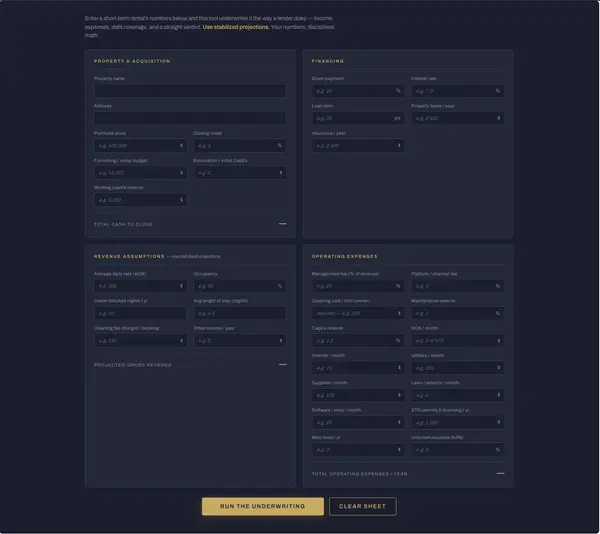
Before acquiring another STR, you can model the purchase price, financing, revenue assumptions, operating expenses and reserves to better understand projected NOI, DSCR, cash flow, cap rate and other investment metrics.
Don't borrow against a good property simply because you can.
Know what the next dollar is expected to accomplish first.

3. Reinvest in the Property You Already Own
Sometimes the best opportunity isn't another acquisition.
It may be sitting in the property you already own.
STR markets evolve.
A cabin that competed extremely well five years ago may now be competing against newer properties with upgraded outdoor living spaces, theaters, game rooms, pools, luxury furnishings and professionally designed interiors.
That creates another potential use of capital.
Could an outdoor entertainment area improve the guest experience?
Could adding or redesigning an amenity increase booking appeal?
Would replacing dated furnishings improve photography and conversion?
Could professional interior design support a higher ADR?
Would a strategic renovation help reposition the property against newer competition?
Those questions should still be answered financially.
Spending $50,000 on an STR doesn't automatically create $50,000 of additional value, and it certainly doesn't guarantee additional revenue.
The improvement should have a purpose.
If a $50,000 investment has a reasonable opportunity to generate $10,000 or $15,000 in sustainable additional annual cash flow, that's a conversation worth having.
If you're spending $50,000 because you would like the property better afterward, that's a different calculation.
An STR may be a home.
But when you're evaluating its investment performance, it's also a business.
4. Sell and Reallocate the Capital
This option can be surprisingly difficult for successful owners to consider.
We tend to assume there must be something wrong with an investment before we're allowed to sell it.
There doesn't.
Sometimes you've simply won.
Perhaps you purchased at the right time.
The property appreciated.
Guests paid down a meaningful portion of the mortgage.
You collected cash flow along the way.
And now a substantial amount of your wealth is concentrated in a single asset.
At that point, the question isn't necessarily:
"Is this still a good property?"
It might be:
"Is this still the best place for this much of my capital?"
Maybe the answer remains yes.
Or perhaps you want to diversify into multiple properties.
Maybe you want less management responsibility.
Perhaps another real estate sector fits your goals better.
Maybe you're approaching retirement and want to reduce exposure.
Or another market may present an opportunity you find more attractive.
For qualifying investment real estate, a properly structured 1031 exchange may also provide an avenue for deferring recognition of certain capital gains while exchanging into qualifying replacement real estate.
A 1031 exchange has strict rules and deadlines, so tax and legal professionals should be involved before a transaction is structured—not after the property has already been sold.
Selling a successful property isn't admitting the investment failed.
Sometimes it's simply the next stage of the investment.
Don't Chase Higher Returns Without Understanding the Risk
After seeing an 8% simplified cash return on equity, it would be easy to think:
"Then I should pull out as much equity as possible and buy more real estate."
Not necessarily.
Higher potential return often comes with higher risk.
More leverage means more debt service.
More properties mean more roofs, HVAC systems, insurance policies, property taxes, furnishings, repairs and management responsibilities.
A portfolio that looks fantastic at strong occupancy can feel very different when tourism slows or expenses rise.
And borrowing costs matter enormously.
Extracting equity at a significantly higher interest rate than your existing mortgage can materially change the economics of a property that was previously producing excellent cash flow.
That's why equity reallocation can't be evaluated by itself.
Interest rates matter.
Cash flow matters.
Debt-service coverage matters.
Reserves matter.
Taxes matter.
Risk tolerance matters.
Your stage of life matters.
And your ultimate objective matters most.
For owners evaluating the broader Smoky Mountain STR environment, I've also created the Smoky Mountain Intelligence Report as another resource for understanding the market beyond an individual property.

What If You've Never Calculated Your Equity?
Then that's probably where this conversation should begin.
You don't need an elaborate spreadsheet.
Start with a few basic pieces of information:
Your property's reasonable current market value.
Your current loan balance.
Your realistic annual cash flow after operating expenses and debt service.
Your approximate gross equity.
Then calculate the relationship between the two.
And ask yourself a question that can be surprisingly revealing:
If I had the amount of my current equity sitting in cash in front of me today, would I invest all of it into this same property at today's value for the return it's currently producing?
If the answer is yes, great.
Now you understand why you're holding it.
Perhaps the cash return is attractive.
Perhaps the property has strong appreciation potential.
Maybe its lower leverage provides exactly the stability you want.
Or maybe it's simply an asset you understand, enjoy owning and have no desire to disturb.
All legitimate reasons.
But if your answer is:
"I'm not sure."
That's worth exploring.
You can start by getting a better understanding of the property's current market value through the:
Then, if you're considering reallocating capital into another property, run that potential acquisition through the SCALE Property Analyzer before making the next move.
And for more articles covering STR ownership, buying, selling, housing trends, investment analysis and homeownership, visit the SCALE Real Estate Blog.
Frequently Asked Questions About STR Equity
What is equity in a short-term rental?
Equity is the difference between the property's estimated current market value and the debt secured by the property. For example, an STR worth $850,000 with $350,000 of secured debt has approximately $500,000 in gross equity before considering selling costs, taxes or other transaction expenses.
What is cash return on equity for a rental property?
For purposes of this analysis, cash return on equity compares annual pre-tax cash flow after operating expenses, routine reserves and debt service with the owner's estimated current gross equity. It helps an owner evaluate how much current cash income is being generated relative to the equity tied up in the property.
Is a higher return on equity always better?
No. A higher potential return may also involve greater leverage or risk. An owner may intentionally maintain substantial equity to reduce debt, protect cash flow and improve financial stability. Return should be evaluated alongside risk, liquidity, taxes and the owner's objectives.
Should I refinance my STR to access equity?
Not automatically. Refinancing or otherwise borrowing against an STR can increase debt service and financing costs. The owner should compare the expected benefit of using the capital with the cost of the new debt and the additional risk to the existing property.
Can I use a 1031 exchange when selling a short-term rental?
A short-term rental may potentially qualify for a Section 1031 like-kind exchange when it meets applicable requirements for real property held for investment or business purposes. Personal use and other circumstances can affect eligibility. Because Section 1031 exchanges have specific qualification, timing and transaction requirements, owners should consult qualified tax and legal professionals before structuring a sale.
Equity Creates Options. Knowing You Have Them Is the First Step.
There isn't one correct strategy.
One STR owner may look at $500,000 in gross equity and see security.
Another sees capital that might help acquire another property.
Someone else sees an opportunity to reinvest into an aging STR and improve its competitive position.
Another investor may decide they've reached the point where selling, exchanging or reducing exposure makes more sense than continuing to operate the property.
All four could be making intelligent decisions.
Because the issue isn't whether equity should always stay in a property or always be redeployed.
The issue is whether the decision is intentional.
Your STR may be producing revenue every night.
Your guests may be paying down your mortgage every month.
Your property may have appreciated substantially since you purchased it.
And while you've been focused on bookings, occupancy and gross revenue, your equity position may have quietly become one of the largest assets on your personal balance sheet.
That's a good problem to have.
But equity creates choices only when you understand how much you have, what it's currently producing, what purpose it's serving and what alternatives are available.
So here's the question I'd leave every STR owner with:
If you discovered substantial equity in your STR today, what would you do?
1. Leave it in place for security.
2. Access some of it and acquire another property.
3. Reinvest into improvements designed to increase revenue.
4. Sell and explore a 1031 exchange or another investment opportunity.
5. I honestly haven't calculated my equity or return on equity.
There isn't a universal answer.
But there should be an intentional one.

Continue Your Research
Explore the SCALE Real Estate Blog
Find Out What Your Property May Be Worth
Analyze Your Next Property with the SCALE Property Analyzer
Explore the Smoky Mountain Intelligence Report
Watch the SCALE Podcast
SCALE with LPT Realty | Pigeon Forge • Sevierville • Gatlinburg • East Tennessee
Investment Note
The return-on-equity examples in this article use annual cash flow after operating expenses and debt service divided by estimated current gross equity as a simplified measure of how existing equity is producing cash income. A complete investment analysis may also consider principal reduction, appreciation, taxes, depreciation, transaction costs, financing costs, capital expenditures and other factors. Appreciation is not guaranteed, and gross equity is not necessarily the amount that can be accessed through a sale or financing. These examples are educational and are not tax, legal or investment advice.
Categories
Recent Posts







GET MORE INFORMATION